
 Login
Login Register
Credit After a Short Sale — The Honest Comparison to Foreclosure
Posted on 28. Sep, 2026 by ctlms in Blog, My Blog, Short Sale, foreclosure
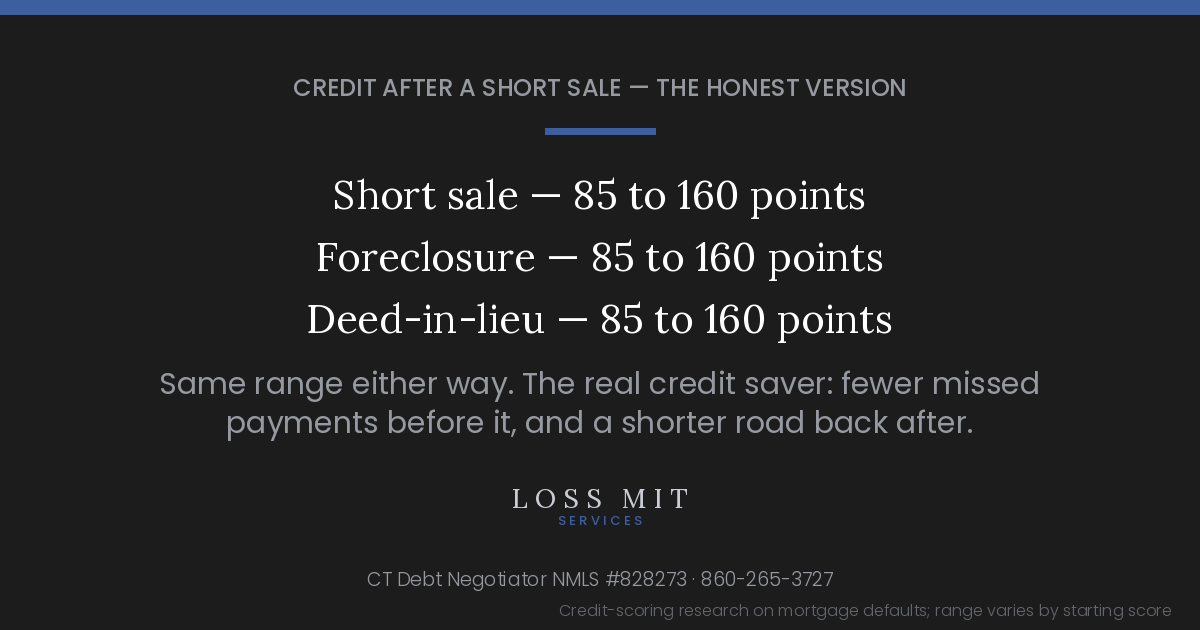
“Doesn’t a short sale look better on my seller’s credit than a foreclosure?” I get some version of this question from listing agents and attorneys almost every time a file gets referred to me, usually because the seller asked them first and they want to give a good answer. It’s a fair question. I wish I could just say yes. The honest answer is closer, and a lot more useful, than that.
Do credit scores actually treat a short sale differently than a foreclosure?
Not the way most people assume. A credit scoring model doesn’t have a category called “short sale” and a separate one called “foreclosure.” It scores what actually gets reported to the credit bureau about the account: paid as agreed, settled for less than the full balance, charged off, ninety-plus days late, and so on. A short sale and a foreclosure usually get reported as some version of “not paid in full,” coming off what was probably a clean payment history before the trouble started. The label on the closing paperwork doesn’t change what the algorithm sees. What changes the score is the derogatory mark itself.
So how big is the hit, really?
Bigger than most sellers expect, and close to the same either way. Credit-scoring research on mortgage defaults puts the drop at roughly 85 to 160 points, and that range applies whether the account closes as a short sale, a foreclosure, or a deed-in-lieu. Where you land in that range depends mostly on where you started. A seller sitting at 780 loses more, in raw points, than a seller sitting at 640 — the higher the score, the more room it has to fall. I tell every referring agent this up front, because the seller is going to hear it from someone eventually, and I’d rather it be on day one than from a lender six months from now.
Where does the real credit saving come from?
Here’s the part nobody explains to the homeowner, and it’s the whole reason the timing of the referral matters more than anything I do on the file once I have it.
The short sale itself is one derogatory entry. Every missed mortgage payment leading up to it is another one. Thirty days late gets reported. Sixty days late gets reported. Ninety, a hundred and twenty, each one is its own mark on the report, and each one stacks on top of the last. By the time a seller has ridden it out for a year and then finally calls somebody, the short sale is landing on top of twelve months of lates, and the score at the end reflects all of it.
Now compare that to the seller who gets a file to me while they’re still current, or one payment behind. The short sale still hurts. It still lands somewhere in that 85 to 160 range. But it’s landing on a clean history instead of a year of missed payments, and the score at the end is in a completely different place. Same short sale, very different result. The fewer missed payments on the report, the smaller the total hit.
That is the honest version of “a short sale is better for your credit.” It isn’t better because of what it’s called. It’s better because a seller who deals with it early takes one hit instead of thirteen. Being proactive is the credit saver. The short sale is just the vehicle.
What about qualifying for a mortgage again?
This is the second real advantage, and it points in exactly the same direction.
- Fannie Mae cuts the wait roughly in half. A conventional buyer needs 7 years after a foreclosure to qualify again, or 3 years with documented extenuating circumstances. After a short sale, that number drops to 4 years standard, or 2 years with extenuating circumstances. Same credit hit, half the wait.
- FHA is 3 years after either one. FHA doesn’t distinguish much between a short sale and a foreclosure on the standard timeline — both are a 3-year wait.
- FHA has a zero-wait path, and it rewards the proactive seller. If your seller’s mortgage payments and every other monthly debt — credit cards, car loan, student loans, all of it — were current for the full 12 months before the short sale closes, FHA doesn’t require any waiting period at all. That’s a real advantage, and it’s the one most agents have never heard of. Notice who qualifies for it: the seller who stayed current. The same seller who took the smaller credit hit.
The advice that costs your seller both
Here’s where I have to say the uncomfortable thing out loud, because I see this go wrong. Somewhere along the way, somebody tells the homeowner to stop making the mortgage payment during the short sale process — sometimes it’s framed as “it’ll make the file move faster,” sometimes as “you won’t need the money anyway once it closes.” Every missed payment that follows is another mark on the report, and the first one takes the FHA zero-wait path off the table. Nobody explains that trade to the seller at the time. I do, every time it comes up, because it’s the difference between your seller buying again next year and your seller buying again in three, with a lower score when they get there.
[story — a referred file where the seller had been told to stop paying months before it reached me, and what that cost them on both the score and the zero-wait path. Fill in or delete before publishing.]
One more thing that moves the needle
Whether the file closes with a deficiency balance or without one. A short sale negotiated to a full release, with no money still owed on paper, tends to land a little softer than one that reports a balance still outstanding. That’s one more reason how a short sale gets negotiated matters, not just that it happened instead of a foreclosure.
The takeaway
A short sale does not spare your seller’s credit the way the old sales pitch claims. The score drop lands in roughly the same range as a foreclosure — 85 to 160 points, worse for higher starting scores — and anyone telling a seller otherwise is setting them up for a bad surprise later. What actually limits the damage is getting there early: fewer missed payments before the short sale means a smaller total hit, and it keeps the FHA zero-wait path and the shorter Fannie Mae timeline in play. That’s the pitch that holds up, because it’s the true one.
Tell your seller the real version. A short sale isn’t a credit-repair strategy. Getting the file to me early is the closest thing to one.
Send me the address and the approximate payoff. I’ll tell you within a day whether it’s worth pursuing, and what the road back looks like for that seller’s loan type.
As always, feel free to reach out to me with any questions.
Sean Wilder
Loss Mit Services
860-265-3727
CT Debt Negotiator NMLS #828273
Loss Mit Services is a dba of Accredited Home Services, LLC · CT Debt Negotiation License DN-828273
Connect with Us


Bio

Sean Wilder started in the pre-foreclosure business in 2007. Previously he enjoyed successbusiness in the transportation industry, real estate investing and as a licensed Realtor. Sean brought the same determination and work ethic that lead to great success in his previous businesses to Loss Mit Services based in East Windsor, CT. His focus, combined with his drive to succeed, have been essential to his success as one of the area's top short sale negotiators.
Known for finding creative ways to overcome hurdles and never ending persistence; Sean, believes in the power of team. Sean and his team are in the trenches everyday, plowing through challenges and objections while negotiating with various lenders, and finding solutions to difficult problems. It is this daily experience that brings Loss Mit Services consistent success and provides them the knowledge to share.
Sean belongs to a number of industry groups and associations that allow him to collaborate, share, learn, teach and stay updated on the latest changes in the pre-foreclosure industry at the federal, state, local and lender specific levels.
Effective Oct 1, 2009 all debt negotiation companies that offer loan modification, short sale, or foreclosure rescue services needed to be licensed by the CT Dept of Banking. Sean and his company Loss Mit Services were the 1st to be awarded the Debt Negotiation License NMLS # 828273 which can be verified at the CT Dept of Banking Website by Clicking Here. In addition, effective Oct 1, 2011 Debt Negotiators were required to also be licensed Mortgage Loan originators and Sean also has received this license, NMLS# LO-831853.

Recent Comments