
 Login
 Register

How Long Does a Connecticut Foreclosure Actually Take? Here Is Where the 1,626 Days Go
Posted on 24. Nov, 2026 by ctlms in Blog, Foreclosures, My Blog, News, Real Estate, Short Sale, foreclosure
I get this question from agents all the time: “My seller just got served. How long do we actually have?” The honest answer is longer than most people think, and shorter than the seller is hoping, and the difference depends almost entirely on what the homeowner does in the first 15 days.
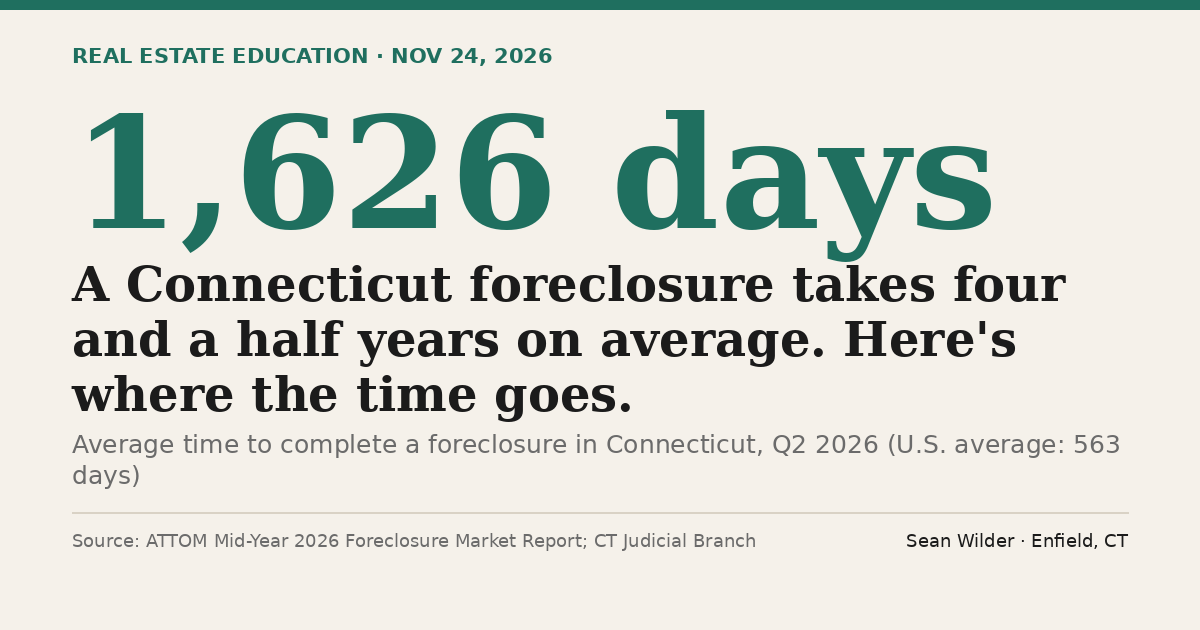
Start with the big number. ATTOM’s mid-year 2026 report has the average Connecticut foreclosure that completed in the second quarter taking 1,626 days from first filing to the end. That is four and a half years, the fourth-longest timeline in the country, behind Louisiana, Hawaii and New York. The national average is 563 days. People read that and assume the banks here are slow. Some are. But most of that time is not the bank. It is the calendar Connecticut law hands the homeowner, and every box on that calendar is a chance to do something.
Here is how it actually runs.
Before anything is filed
Federal mortgage servicing rules generally bar the servicer from making the first foreclosure filing until the loan is more than 120 days delinquent. So the earliest a Connecticut case can start is roughly month five of missed payments. Before that, the servicer is supposed to be reaching out about options. Most homeowners I talk to spent those months not opening the mail, which is the first place the timeline gets wasted.
The complaint and the return date
Connecticut is a judicial foreclosure state. The bank has to sue. A state marshal serves a summons and complaint, and the summons carries a “return date,” which by rule is always a Tuesday. The return date is NOT a court hearing and nobody loses a house on it. It is the date the court uses to count every deadline that follows.
Two things are due right after it. An appearance, the form that tells the court the homeowner is in the case, is due two days after the return date. Then, if the homeowner lives in the house, it is a one-to-four family, and their name is on the note, they can file a Foreclosure Mediation Certificate within 15 days of the return date. That one form is the single most important piece of paper in the whole process, and it is the one that gets missed.
What mediation does to the clock
The Foreclosure Mediation Program is run by the Judicial Branch. The mediator is a court employee, usually a lawyer, who does not represent either side and does not give legal advice. There is no fee and no lawyer is required. Once an eligible homeowner files the certificate, the bank’s participation is mandatory.
The statute, C.G.S. 49-31l, sets the deadlines. The bank has to deliver the account history, a reinstatement figure, its financial forms and copies of the note and mortgage by the 35th day after the return date. The first meeting with the mediator, without the bank, happens by day 49. That premediation phase ends by day 84. Then come the sessions with the bank’s lawyer in the room. Per the Judicial Branch’s own FAQ, the mediation period runs until the earlier of seven months after the return date or three sessions, and it can be extended by motion.
Here is the part agents should understand. For a period of up to eight months from the return date, neither side can file most motions in the case. And the court cannot enter a judgment of strict foreclosure or foreclosure by sale while the mediation period is running. The bank’s lawyer is sitting on the file whether they like it or not. The program is currently authorized for return dates through June 30, 2029.
So what gets talked about in mediation? The Judicial Branch lists it: reinstatement, a repayment plan, a loan modification, a sale, a short sale, a deed in lieu, and the timing of law days and sale dates. A short sale is on the court’s own list of outcomes. The mediator will put it on the table. Whether the servicer approves one is a separate question nobody can promise, but the clock the program creates is exactly the window a short sale needs. Lender approval on a short sale commonly runs 60 to 120 days by itself, and a file that starts in month one of mediation has room. A file that starts the week before the law day does not.
Judgment: strict foreclosure versus foreclosure by sale
When mediation ends without a deal, the bank moves for judgment. Connecticut does something most states do not. If there is not enough equity in the property to make an auction worthwhile, the court grants a judgment of strict foreclosure, with no sale at all. The court sets a “law day.” Per the Connecticut Fair Housing Center’s homeowner guide, the law day is usually 45 to 90 days after judgment, and can be as soon as 21. The homeowner can redeem by paying everything owed, including fees, costs and interest, up to that day. If they do not, title passes to the bank the day after. No auction, no bidding, no excess proceeds, because there were none to fight over.
If there IS real equity, the court orders a foreclosure by sale instead. A court-appointed committee runs the auction, usually 60 to 90 days after judgment, the court approves the sale a few weeks later, and anything left after the debt gets paid out. Either way, after title passes, the bank can get an execution of ejectment, and the removal can come within days of the marshal delivering it. A motion to open the judgment can ask for more time, and it has to be decided before the law day.
For the legal mechanics of any of that, the homeowner needs a real estate attorney. I am not one and neither are you.
Where the 1,626 days actually come from
Add it up. Four-plus months before filing. Eight months of stay. Mediation extensions. A motion to open. A sale that gets postponed. A second mediation request after a modification falls apart. Every step is a chance to reinstate, modify, sell, or work out a short sale, and homeowners who use them stretch the calendar. Homeowners who do not open the mail blow through it. Both groups land in the same average.
The takeaway
1. The 15-day mediation deadline is the whole game. If a seller tells you they were served, the first question is the return date on the summons, and the second is whether the mediation certificate is filed. Eligible owner-occupants who file it buy themselves most of a year of court-supervised breathing room.
2. The stay is the short sale window. Up to eight months with no judgment possible is the time a short sale actually takes to get through a servicer. A listing that goes up in that window has a chance. One that goes up in the last 30 days before a law day is a prayer.
3. Nobody should stop paying, stop answering the servicer, or wait for the law day to think about options. The homeowner who redeems, modifies or sells does it on the calendar above, and the calendar is public.
If you have a seller somewhere on this timeline and you are not sure where, send me the address and the approximate payoff. I’ll tell you within a day whether a short sale is worth pursuing and where they are on the clock.
As always, feel free to reach out to me with any questions.
Sean Wilder
Loss Mit Services
860-265-3727
CT Debt Negotiator NMLS #828273
Loss Mit Services is a dba of Accredited Home Services, LLC · CT Debt Negotiation License DN-828273
Sources
ATTOM Mid-Year 2026 U.S. Foreclosure Market Report (July 2026). Connecticut Judicial Branch, Foreclosure Mediation Program Homeowner FAQ. Connecticut General Statutes section 49-31l. Connecticut Fair Housing Center, Representing Yourself in Foreclosure: A Guide for Connecticut Homeowners, 12th edition. CFPB Mortgage Servicing Rules Small Entity Compliance Guide (12 CFR 1024.41).
Connect with Us


Bio

Sean Wilder started in the pre-foreclosure business in 2007. Previously he enjoyed successbusiness in the transportation industry, real estate investing and as a licensed Realtor. Sean brought the same determination and work ethic that lead to great success in his previous businesses to Loss Mit Services based in East Windsor, CT. His focus, combined with his drive to succeed, have been essential to his success as one of the area's top short sale negotiators.
Known for finding creative ways to overcome hurdles and never ending persistence; Sean, believes in the power of team. Sean and his team are in the trenches everyday, plowing through challenges and objections while negotiating with various lenders, and finding solutions to difficult problems. It is this daily experience that brings Loss Mit Services consistent success and provides them the knowledge to share.
Sean belongs to a number of industry groups and associations that allow him to collaborate, share, learn, teach and stay updated on the latest changes in the pre-foreclosure industry at the federal, state, local and lender specific levels.
Effective Oct 1, 2009 all debt negotiation companies that offer loan modification, short sale, or foreclosure rescue services needed to be licensed by the CT Dept of Banking. Sean and his company Loss Mit Services were the 1st to be awarded the Debt Negotiation License NMLS # 828273 which can be verified at the CT Dept of Banking Website by Clicking Here. In addition, effective Oct 1, 2011 Debt Negotiators were required to also be licensed Mortgage Loan originators and Sean also has received this license, NMLS# LO-831853.

Recent Comments