
 Login
 Register

Short Sales Take Forever: The Honest Timeline and Where the Time Really Goes
Posted on 19. Oct, 2026 by ctlms in Blog, Foreclosures, My Blog, News, Real Estate, Short Sale, foreclosure
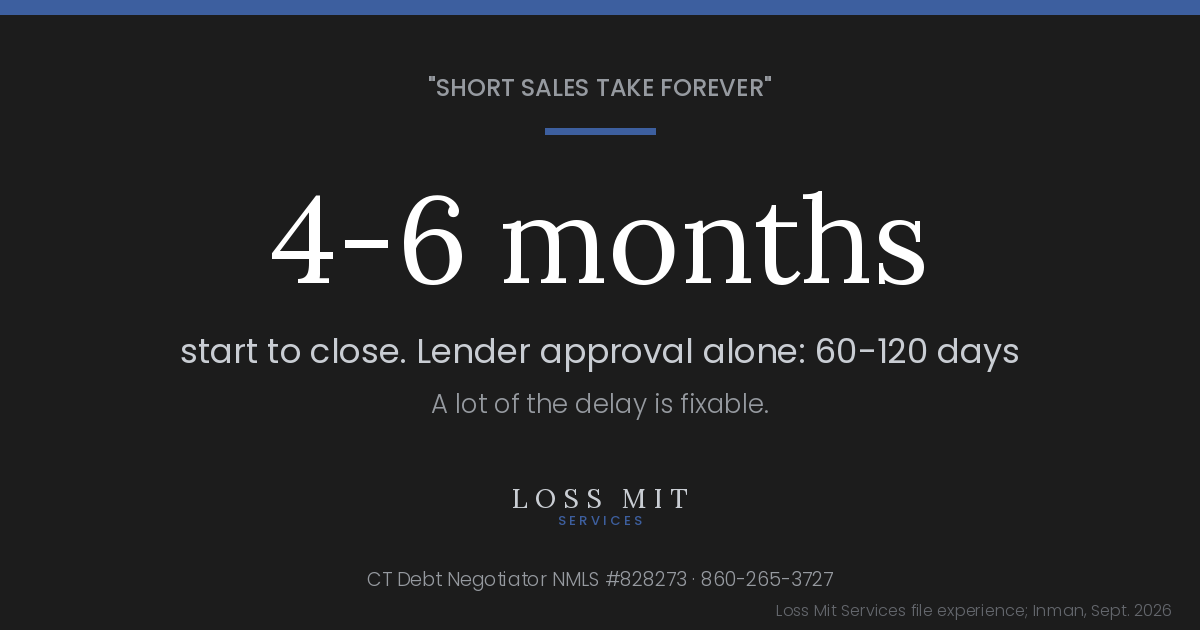
“Short sales take forever.” I hear that from agents all the time, usually right before they tell me they stopped taking these listings. And I’m not going to argue with them, because mostly they’re right. The myth isn’t that a short sale is slow. The myth is that it’s slow for no reason, and that nobody can do anything about it. So let’s talk about the real timeline, where the time goes, and which parts you can actually control.
How long does a short sale really take?
Start to close, a short sale typically runs four to six months, and sometimes longer. Lender approval by itself commonly takes 60 to 120 days, and that is before the closing window written into the approval letter. You will not get a normal 30-day escrow out of one of these, and you shouldn’t tell your seller you will.
If you were told two to four months, that’s the old number. It’s the one that got a lot of agents burned. They set an expectation with the seller and the buyer, month three came and went with no answer, and the buyer walked. I’d rather you hear the long number from me now than discover it yourself in month three.
Why does it take so long?
Think about who has skin in the game. The mortgage servicer is the company you send your payments to, and it gets paid every month to service that loan. Resolving a delinquent file faster doesn’t put money in the servicer’s pocket. Behind the servicer there is often an investor who owns the loan and has to sign off, and the bank has been burned on sloppy paperwork before, so it checks everything twice. A valuation gets ordered. A negotiator gets assigned. Files get passed from one desk to another.
So the process moves at the speed of the slowest person in the chain, and nobody in the chain is being paid to hurry. That part isn’t fixable. I’d be lying if I said otherwise.
Where does the time get lost?
Here is what we see on files, in the order I see it. Most of it isn’t the bank.
- The package comes back incomplete. A missing signature, a form that wasn’t filled out all the way, a bank statement with a page missing. The bank doesn’t call and ask nicely. It sends the file back, and you go to the back of the line. Dot your I’s and cross your T’s, because the bank does care about the minor error.
- The income documents go stale. The seller sends pay stubs and bank statements, the file sits in review for six weeks, and now the documents are too old to use. Everything gets re-sent, and the clock starts over on that piece.
- A second lien nobody asked about. A second mortgage, a home equity line, an HOA balance, a municipal lien. If you don’t find it until month three, it sinks an otherwise clean file, because now there is another party who has to say yes. Ask for the title information on day one.
- Nobody owns the follow-up. A file that nobody calls on for two weeks doesn’t sit still, it drifts backward. Somebody has to be on the phone, every week, with the servicer.
Those four are what an agent and a negotiator can actually control. That’s the reason I want to see a file early, before the first price reduction and well before the buyer is losing patience.
Does a short sale ever move quickly?
Sometimes a lender moves faster than expected. I’ve seen it happen. But a short sale is not a short sale, every one is its own file with its own servicer, investor and lien structure, and I wouldn’t build a plan around the fast one. Plan for the long number and be pleasantly surprised if you get the short one.
What do I tell my seller and my buyer?
Tell them the truth up front. Four to six months, sometimes longer, and nobody can promise how long theirs will take. Nobody can promise an approval either, not me, not the bank’s own rep on the phone. A short sale can hurt the seller’s credit, and I won’t pretend otherwise. And lenders commonly ask for a reduction in your commission, so you want that conversation early, not at closing.
Whether a short sale is right for your seller is a decision for the seller. Questions about taxes belong with a CPA, and questions about the legal side belong with a real estate attorney. I’m neither one.
The takeaway
Short sales are slow. That part of the myth is true. But a lot of the delay is fixable, and the most fixable piece is when the file gets started and how complete the package is when it goes in. Raise it early, get the payoff and lien information on day one, and set the long expectation from the beginning.
If you have a listing where the payoff is higher than any realistic price, send me the address and the approximate payoff. I’ll tell you within a day whether it’s worth pursuing.
As always, feel free to reach out to me with any questions.
Sean Wilder
Loss Mit Services
860-265-3727
CT Debt Negotiator NMLS #828273
Loss Mit Services is a dba of Accredited Home Services, LLC · CT Debt Negotiation License DN-828273
Connect with Us


Bio

Sean Wilder started in the pre-foreclosure business in 2007. Previously he enjoyed successbusiness in the transportation industry, real estate investing and as a licensed Realtor. Sean brought the same determination and work ethic that lead to great success in his previous businesses to Loss Mit Services based in East Windsor, CT. His focus, combined with his drive to succeed, have been essential to his success as one of the area's top short sale negotiators.
Known for finding creative ways to overcome hurdles and never ending persistence; Sean, believes in the power of team. Sean and his team are in the trenches everyday, plowing through challenges and objections while negotiating with various lenders, and finding solutions to difficult problems. It is this daily experience that brings Loss Mit Services consistent success and provides them the knowledge to share.
Sean belongs to a number of industry groups and associations that allow him to collaborate, share, learn, teach and stay updated on the latest changes in the pre-foreclosure industry at the federal, state, local and lender specific levels.
Effective Oct 1, 2009 all debt negotiation companies that offer loan modification, short sale, or foreclosure rescue services needed to be licensed by the CT Dept of Banking. Sean and his company Loss Mit Services were the 1st to be awarded the Debt Negotiation License NMLS # 828273 which can be verified at the CT Dept of Banking Website by Clicking Here. In addition, effective Oct 1, 2011 Debt Negotiators were required to also be licensed Mortgage Loan originators and Sean also has received this license, NMLS# LO-831853.

Recent Comments