
 Login
 Register

The Divorce Listing Where the Payoff Won’t Clear: When to Call a Short Sale Negotiator
Posted on 16. Oct, 2026 by ctlms in Blog, Foreclosures, My Blog, News, Real Estate, Short Sale, foreclosure

“Neither of them can keep the house, and the payoff is higher than anything we’re going to get for it. Now what?” I hear some version of that from agents who take a divorce listing and run the numbers at the kitchen table. It usually comes a few weeks too late, after a price reduction or two, and after the two owners have stopped being on speaking terms. So here’s the trigger I want you to listen for, and what I’d do about it.
What makes a divorce listing different?
Most underwater listings have one decision maker, or two who are still on the same team. A divorce listing has two owners who want out of the same loan and, in many cases, no longer want to deal with each other.
Here’s the WHY it gets stuck. Nobody is keeping the house. Neither person can refinance it, because the payoff is more than the property is worth, and nobody refinances into a loan bigger than the house. Neither wants to keep paying on it either, since that means carrying a debt on a place they don’t live in, or one they can’t afford alone. So the only exit is a sale, and the sale doesn’t clear the payoff.
Who is actually on the hook?
This is the part that surprises people. In most of these files both spouses are on the mortgage and on title. What the two of them have agreed to between themselves, or what a court has said about who pays what, doesn’t change who signed the note. The lender doesn’t care who got the house in the settlement. The lender cares who is on the loan.
How a divorce decree treats the mortgage, and what it means for each spouse, is a legal question. That’s one for the divorce attorney or a real estate attorney, not for me and not for you. If your seller’s attorney is going to have an opinion, you want to hear it before the listing agreement turns into a surprise.
What actually stalls these files?
Three things, in the order I see them.
- Both owners generally have to sign. Every authorization, every form, every disclosure, from both people, and often ink signed. When the two of them are barely communicating, one person sits on the paperwork for two weeks and the whole file waits. The agent in the middle ends up playing messenger, and that’s rarely what you signed up for.
- The clock. A short sale commonly runs four to six months from start to close, and lender approval alone commonly takes 60 to 120 days. That is a long time to ask two people in the middle of a divorce to stay cooperative, stay reachable and keep returning documents on time. Some will. Some won’t. It’s much easier when we all know on day one how long the road is.
- The late conversation. By the time the third price reduction goes up, the listing has been sitting for months, the buyers who would have made an offer have moved on, the sellers are worn out, and the file starts with a much shorter runway. Most of the damage in these files is time that was already gone before anyone raised a short sale.
What should you do at the listing appointment?
Get the payoff statement first. Not an estimate, the actual payoff, including every lien on the property. Then compare it honestly to where the market is. If it clears with room to spare, you have a regular listing. If it doesn’t, and neither side can bring money to the table or refinance, that’s the moment to ask whether a short sale is worth looking at. Notice I said “looking at.” Whether it’s the right path for those two people is their decision, and it’s something to take up with their own attorneys and a CPA about the tax side. I’m not either of those, and I don’t pretend to be.
And if it is on the table, I’ll be straight with you about what comes with it. A short sale can hurt the sellers’ credit. The lender decides whether to approve it, based on its own guidelines, not on how sympathetic the situation is. Lenders commonly ask for a reduction in commission, and I’d rather you hear that now than at closing. Nobody can promise an approval, including me.
The takeaway
Divorce, a payoff above any realistic list price, and neither owner able to refinance or carry the loan. That combination should make you pick up the phone before the first price reduction. Get the payoff, raise the possibility early, route the legal and tax questions to the right professionals, and let us help you with the part we do every day.
Send me the address and the approximate payoff. I’ll tell you within a day whether it’s worth pursuing.
As always, feel free to reach out to me with any questions.
Sean Wilder
Loss Mit Services
860-265-3727
CT Debt Negotiator NMLS #828273
Loss Mit Services is a dba of Accredited Home Services, LLC · CT Debt Negotiation License DN-828273
What a Short Sale File Actually Starts With — and Why It’s Shorter Than You Think
Posted on 05. Oct, 2026 by ctlms in Blog, My Blog, Short Sale, foreclosure
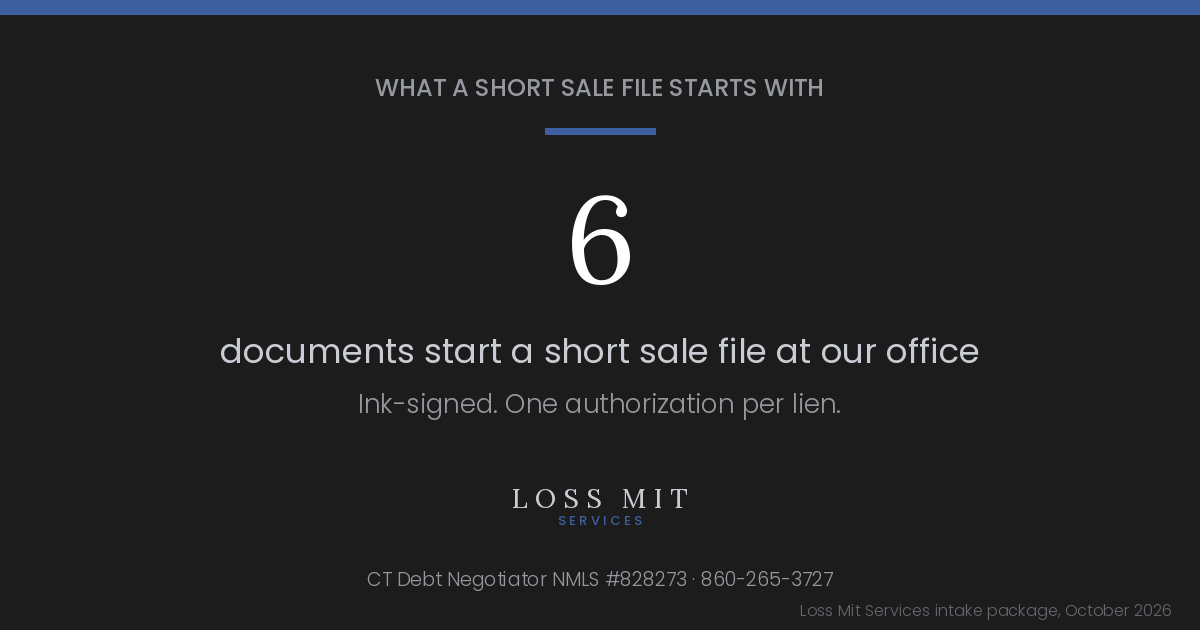
“What does my seller actually have to give you to get this started?” I get that question from agents the minute a file is referred, and it usually comes with a worried tone, because most agents have been burned by a short sale that started with a three-inch stack of paperwork and a seller who stopped returning calls halfway through. So here’s exactly what a file at my office starts with. It’s six things, and it’s shorter than you’d expect on purpose.
What are the six things?
I send the seller one email with the documents attached, and here’s what’s in it.
- The authorization to release information. This gives the lender permission to speak with us about the account. Without it they will not discuss a short sale with us, period. We need one for each lender or lien on the property, so a first and a second mortgage means two signed copies, and a judgment or a home equity line means another. This is the one that matters first, because nothing else can move until it’s on file.
- A basic income and expense form. It’s a plain worksheet: monthly income for each borrower, what the seller owns, and what goes out each month. Nothing fancy. We ask the seller to fill it out as clearly and completely as they can.
- A hardship letter. In the seller’s own words, what happened that made the mortgage unaffordable, and what has changed since. Servicers want to see it, and it has to be true and it has to be theirs.
- The debt negotiation agreement. This is the three-page disclosure Connecticut requires. It spells out what we offer to do, and it’s blunt about the possible results: nobody can guarantee the lender will approve a short sale, a short sale can hurt the seller’s credit, and the seller has three business days to cancel. I’d rather the seller read all of that on day one than be surprised by it in month four.
- The short sale questionnaire. This one is the sleeper, and I’ll explain why in a minute.
- A copy of the mortgage statement. Plus whatever the seller has on any other liens.
One more thing that surprises people: everything has to be ink signed. No electronic signatures. Mailed copies should be copies, not originals.
Why only six? Where are the pay stubs and bank statements?
They come later, and that’s deliberate. Here’s the WHY.
Before the authorization is on file, I don’t know anything useful about the loan. Once the lender has it, we find out who actually owns the loan, whether it’s government insured, whether there’s mortgage insurance, and what documents that particular servicer wants to see from the seller along with the offer. Who owns the loan is the first thing you need to know on any short sale, and every investor has different requirements. Collecting a generic pile of documents before we know what this lender wants is how you end up collecting the wrong pile.
And then there’s the clock. Fannie Mae’s servicing guide says income documents can be no more than 90 days old as of the date the servicer first determines the package is complete. A short sale runs four to six months from start to close, with lender approval alone commonly taking 60 to 120 days. So if you have the seller gather pay stubs and bank statements in week one, there’s a real chance you’ll be asking for them again in month three. Nobody enjoys asking a stressed-out homeowner for the same paperwork twice, and homeowners who get asked twice have a way of going quiet.
Why does the questionnaire matter so much?
Because it’s where the file-killers show up early. It asks who the other lienholders are, whether there’s an HOA and whether the dues are current, whether water, sewer or town services are behind, whether the property is owner-occupied, rented or vacant, and whether the seller has ever filed bankruptcy or is planning to. It asks about military service. It asks about other real estate. Every one of those answers changes how the file gets handled.
A second mortgage nobody mentioned, HOA arrears, a bankruptcy where the liens weren’t dealt with. Those are the things that stall a closing, and the question is only whether you hear about them on day one or from the closing attorney the week before the closing date. I know which one I prefer. The questionnaire also asks whether the seller has their own real estate attorney with short sale experience, so we aren’t scrambling for one when it’s time to close.
What if the owner has passed away?
Same package, with a few additions. The estate sends a copy of the death certificate, a copy of the fiduciary certificate, and a same name affidavit for the fiduciary, which is what lets the bank accept the fiduciary’s signature on the documents. Everything else on the list stays the same.
Does a complete package mean the lender approves?
No, and I’d be lying if I let you leave with that impression. A complete starting package gets the file opened and moving. After that the lender decides whether to approve it, based on the value of the property, the offer, the investor’s guidelines, and the seller’s hardship and finances. The lender has the final say. That’s what the state-required agreement tells the seller, and it’s what I tell you.
The takeaway
A short sale file starts with six documents: the authorization, an income and expense form, a hardship letter, the debt negotiation agreement, the questionnaire, and a mortgage statement. Get them back signed in ink, and you’ve done the part you can control. The rest of the package gets built to that lender’s specific requirements once we know what they are, which keeps the income paperwork from going stale while the file waits its turn.
Send me the address and the approximate payoff. I’ll tell you within a day whether it’s worth pursuing.
As always, feel free to reach out to me with any questions.
Sean Wilder
Loss Mit Services
860-265-3727
CT Debt Negotiator NMLS #828273
Loss Mit Services is a dba of Accredited Home Services, LLC · CT Debt Negotiation License DN-828273
Credit After a Short Sale — The Honest Comparison to Foreclosure
Posted on 28. Sep, 2026 by ctlms in Blog, My Blog, Short Sale, foreclosure
“Doesn’t a short sale look better on my seller’s credit than a foreclosure?” I get some version of this question from listing agents and attorneys almost every time a file gets referred to me, usually because the seller asked them first and they want to give a good answer. It’s a fair question. I wish I could just say yes. The honest answer is closer, and a lot more useful, than that.
Do credit scores actually treat a short sale differently than a foreclosure?
Not the way most people assume. A credit scoring model doesn’t have a category called “short sale” and a separate one called “foreclosure.” It scores what actually gets reported to the credit bureau about the account: paid as agreed, settled for less than the full balance, charged off, ninety-plus days late, and so on. A short sale and a foreclosure usually get reported as some version of “not paid in full,” coming off what was probably a clean payment history before the trouble started. The label on the closing paperwork doesn’t change what the algorithm sees. What changes the score is the derogatory mark itself.
So how big is the hit, really?
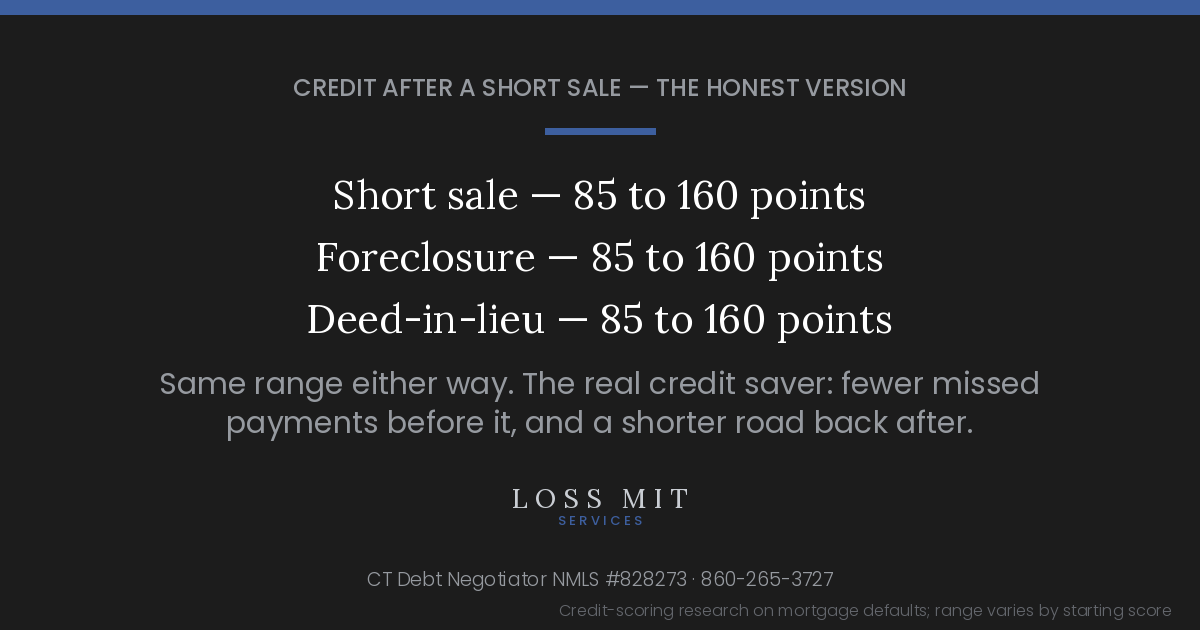
Bigger than most sellers expect, and close to the same either way. Credit-scoring research on mortgage defaults puts the drop at roughly 85 to 160 points, and that range applies whether the account closes as a short sale, a foreclosure, or a deed-in-lieu. Where you land in that range depends mostly on where you started. A seller sitting at 780 loses more, in raw points, than a seller sitting at 640 — the higher the score, the more room it has to fall. I tell every referring agent this up front, because the seller is going to hear it from someone eventually, and I’d rather it be on day one than from a lender six months from now.
Where does the real credit saving come from?
Here’s the part nobody explains to the homeowner, and it’s the whole reason the timing of the referral matters more than anything I do on the file once I have it.
The short sale itself is one derogatory entry. Every missed mortgage payment leading up to it is another one. Thirty days late gets reported. Sixty days late gets reported. Ninety, a hundred and twenty, each one is its own mark on the report, and each one stacks on top of the last. By the time a seller has ridden it out for a year and then finally calls somebody, the short sale is landing on top of twelve months of lates, and the score at the end reflects all of it.
Now compare that to the seller who gets a file to me while they’re still current, or one payment behind. The short sale still hurts. It still lands somewhere in that 85 to 160 range. But it’s landing on a clean history instead of a year of missed payments, and the score at the end is in a completely different place. Same short sale, very different result. The fewer missed payments on the report, the smaller the total hit.
That is the honest version of “a short sale is better for your credit.” It isn’t better because of what it’s called. It’s better because a seller who deals with it early takes one hit instead of thirteen. Being proactive is the credit saver. The short sale is just the vehicle.
What about qualifying for a mortgage again?
This is the second real advantage, and it points in exactly the same direction.
- Fannie Mae cuts the wait roughly in half. A conventional buyer needs 7 years after a foreclosure to qualify again, or 3 years with documented extenuating circumstances. After a short sale, that number drops to 4 years standard, or 2 years with extenuating circumstances. Same credit hit, half the wait.
- FHA is 3 years after either one. FHA doesn’t distinguish much between a short sale and a foreclosure on the standard timeline — both are a 3-year wait.
- FHA has a zero-wait path, and it rewards the proactive seller. If your seller’s mortgage payments and every other monthly debt — credit cards, car loan, student loans, all of it — were current for the full 12 months before the short sale closes, FHA doesn’t require any waiting period at all. That’s a real advantage, and it’s the one most agents have never heard of. Notice who qualifies for it: the seller who stayed current. The same seller who took the smaller credit hit.
The advice that costs your seller both
Here’s where I have to say the uncomfortable thing out loud, because I see this go wrong. Somewhere along the way, somebody tells the homeowner to stop making the mortgage payment during the short sale process — sometimes it’s framed as “it’ll make the file move faster,” sometimes as “you won’t need the money anyway once it closes.” Every missed payment that follows is another mark on the report, and the first one takes the FHA zero-wait path off the table. Nobody explains that trade to the seller at the time. I do, every time it comes up, because it’s the difference between your seller buying again next year and your seller buying again in three, with a lower score when they get there.
[story — a referred file where the seller had been told to stop paying months before it reached me, and what that cost them on both the score and the zero-wait path. Fill in or delete before publishing.]
One more thing that moves the needle
Whether the file closes with a deficiency balance or without one. A short sale negotiated to a full release, with no money still owed on paper, tends to land a little softer than one that reports a balance still outstanding. That’s one more reason how a short sale gets negotiated matters, not just that it happened instead of a foreclosure.
The takeaway
A short sale does not spare your seller’s credit the way the old sales pitch claims. The score drop lands in roughly the same range as a foreclosure — 85 to 160 points, worse for higher starting scores — and anyone telling a seller otherwise is setting them up for a bad surprise later. What actually limits the damage is getting there early: fewer missed payments before the short sale means a smaller total hit, and it keeps the FHA zero-wait path and the shorter Fannie Mae timeline in play. That’s the pitch that holds up, because it’s the true one.
Tell your seller the real version. A short sale isn’t a credit-repair strategy. Getting the file to me early is the closest thing to one.
Send me the address and the approximate payoff. I’ll tell you within a day whether it’s worth pursuing, and what the road back looks like for that seller’s loan type.
As always, feel free to reach out to me with any questions.
Sean Wilder
Loss Mit Services
860-265-3727
CT Debt Negotiator NMLS #828273
Loss Mit Services is a dba of Accredited Home Services, LLC · CT Debt Negotiation License DN-828273
Connect with Us


Bio

Sean Wilder started in the pre-foreclosure business in 2007. Previously he enjoyed successbusiness in the transportation industry, real estate investing and as a licensed Realtor. Sean brought the same determination and work ethic that lead to great success in his previous businesses to Loss Mit Services based in East Windsor, CT. His focus, combined with his drive to succeed, have been essential to his success as one of the area's top short sale negotiators.
Known for finding creative ways to overcome hurdles and never ending persistence; Sean, believes in the power of team. Sean and his team are in the trenches everyday, plowing through challenges and objections while negotiating with various lenders, and finding solutions to difficult problems. It is this daily experience that brings Loss Mit Services consistent success and provides them the knowledge to share.
Sean belongs to a number of industry groups and associations that allow him to collaborate, share, learn, teach and stay updated on the latest changes in the pre-foreclosure industry at the federal, state, local and lender specific levels.
Effective Oct 1, 2009 all debt negotiation companies that offer loan modification, short sale, or foreclosure rescue services needed to be licensed by the CT Dept of Banking. Sean and his company Loss Mit Services were the 1st to be awarded the Debt Negotiation License NMLS # 828273 which can be verified at the CT Dept of Banking Website by Clicking Here. In addition, effective Oct 1, 2011 Debt Negotiators were required to also be licensed Mortgage Loan originators and Sean also has received this license, NMLS# LO-831853.

Recent Comments